
Brand Positioning Strategy: Why Most Brands Sound the Same
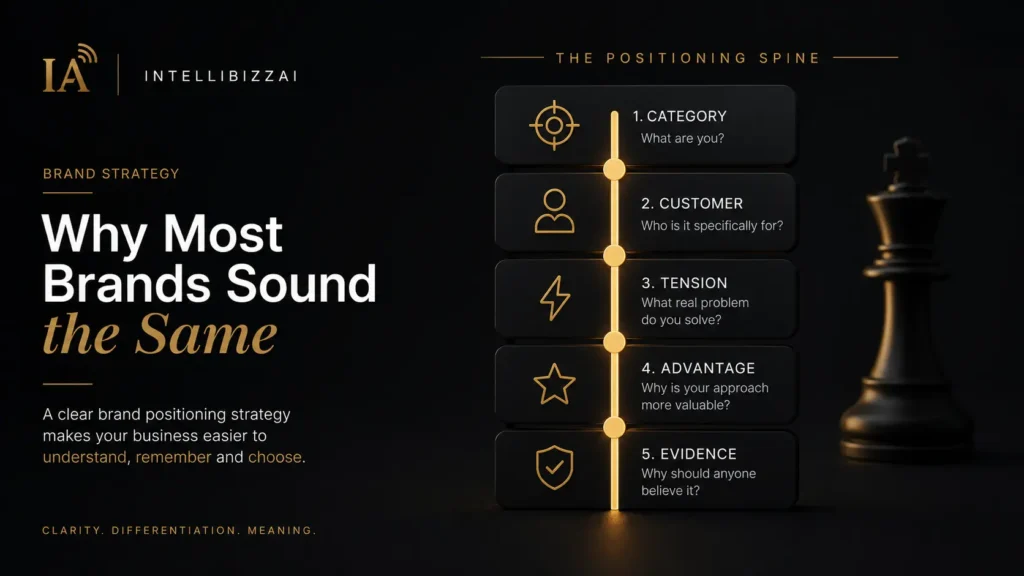
Why Most Brands Sound the Same
Why most brands do not have a creativity problem but a recognition problem, and how the Positioning Spine (category, customer, tension, advantage and evidence) makes a brand clear and distinct.
Most brands do not have a creativity problem. They have a recognition problem.
Their websites are professionally designed. Their social content is consistent. Their presentation looks polished. Yet remove the company name, logo and colours, and the language could belong to almost anyone. They are passionate about quality, committed to innovation, focused on their customers, delivering tailored solutions, helping businesses reach their potential. None of these claims are necessarily false. They are simply too common to create a useful distinction.
A potential customer may understand that the company is competent. They still cannot explain why they should choose it instead of the next competent company. This is the work of brand positioning strategy.
Brand positioning strategy is the strategic decision that defines what a brand should mean in the mind of the right customer. Positioning is not a tagline, a visual style or a paragraph describing the company’s values. It is a choice. Without that decision, branding becomes decoration, content becomes repetition, and marketing becomes louder without becoming clearer.
Key Takeaways – Most brands do not need more adjectives. They need a stronger point of view and a set of actual decisions. – Positioning is not description. It is the strategic choice of category, customer, tension, advantage and evidence. – A brand becomes clear when it decides what it will not try to represent, not just what it will say. – Identity expresses the position; it does not create it. A new logo cannot decide who the brand is for. – The Positioning Spine keeps the offer, messaging, website and content aligned so the brand becomes easy to place and hard to confuse.
Positioning is a choice
Many brands treat positioning as an exercise in description. They gather every service, audience, benefit and ambition into one statement:
“We provide innovative, tailored digital solutions that help businesses of all sizes transform, grow and succeed.”
The statement describes a broad intention. It makes almost no strategic choice. Strong positioning requires choices about the category the business wants to occupy, the people it is best equipped to serve, the problem it wants to be associated with solving, the alternative it wants to be compared against, and the reason its approach is more valuable.
A brand becomes clearer when it decides what it will emphasise. It also becomes clearer when it decides what it will not try to represent. This is why positioning can feel uncomfortable. Every meaningful choice creates boundaries. But without boundaries, customers have nothing definite to remember.
The difference between identity and positioning
Positioning and visual identity are connected, but they are not interchangeable. Positioning determines what the brand should mean. Identity determines how that meaning is expressed.
A visual identity may include the logo, colours, typography, image direction, layout, motion and graphic elements. These elements influence perception immediately. They can make a company feel premium, approachable, technical, established, rebellious or understated. But visual identity cannot permanently solve an unclear strategic foundation.
A beautifully designed brand may still leave customers asking: What does this company actually specialise in? Is the service designed for a business like mine? Why is it different from its competitors? What result should I expect? Why should I trust its approach? When those questions remain unanswered, the visual identity attracts attention without creating enough meaning. The brand looks distinctive. The offer still sounds familiar.

The Positioning Spine
The Positioning Spine is the central strategic structure that keeps the offer, messaging, website and content aligned. It contains five connected decisions:
| # | Decision | Question it answers |
|---|---|---|
| 1 | Category | What are you? |
| 2 | Customer | Who is this specifically for? |
| 3 | Tension | What is the real problem? |
| 4 | Advantage | Why this approach? |
| 5 | Evidence | Why should anyone believe it? |
Each part supports the next. When one is weak, the brand begins to lose definition.

1. Category: What are you?
Customers need a category before they can understand the difference. A business may describe itself as “a creative partner for ambitious organisations.” That sounds positive, but it does not create clear orientation. Is it a branding studio? A marketing consultancy? A software company? A production agency? A business coach?
The category does not need to describe every capability. It needs to give the customer a useful starting point. Examples include brand strategy studio, conversion-focused web design company, fractional marketing team, executive coaching practice, premium property management service, or content production system for founders.
A clear category helps customers understand what kind of decision they are making. Only then can the brand explain why its version of that category is different.
Category clarity is not the same as category conformity. Being understandable does not require sounding identical to competitors. The category provides orientation. The positioning provides distinction. A company can begin with a familiar category and then redefine expectations around its audience, method, delivery model, philosophy, specialisation or outcome. The objective is not to invent an unfamiliar label merely to appear original. It is to become easy to place and difficult to confuse.
2. Customer: Who is this specifically for?
“Businesses” is not a meaningful audience. Neither are entrepreneurs, ambitious brands, modern companies, organisations that want to grow, or anyone looking for quality. These descriptions are technically inclusive but strategically weak.
A useful customer definition considers more than demographics. It identifies a shared situation. For example: Founder-led service businesses that have outgrown their improvised brand and need a more credible digital presence before pursuing larger clients. This audience is defined by business model, stage, problem, ambition and buying context. That is more useful than saying the service is for small and medium-sized businesses.
Position around a buying situation. The strongest audience may not belong to one industry. It may share one important moment: preparing to launch; repositioning after several years of growth; moving into a premium market; struggling to explain a complex offer; attracting attention but failing to convert it; or entering a market where trust is essential. A positioning strategy becomes more powerful when it reflects the situation that causes someone to seek the service.
3. Tension: What is the real problem?
Customers rarely buy because of the surface problem alone. A founder may say, “We need a new website.” The deeper tension may be that the current website makes the company appear smaller than it is, the offer has become difficult to explain, prospects repeatedly ask the same basic questions, the business is losing confidence when approaching larger clients, the visual identity no longer reflects the service quality, or marketing activity is sending people toward an experience that does not convert.
The surface request is a website. The real problem is a gap between the quality of the business and the way the business is perceived. This distinction matters because strong positioning speaks to the tension, not merely the deliverable.
Compare “We design professional websites.” with “We help founder-led businesses replace improvised digital experiences with clear, credible websites built for their next stage of growth.” The second version contains a recognisable transition. It shows what the customer is moving away from and what they are moving toward.
Tension gives the message energy. Without tension, brand messaging becomes a list of positive attributes. With tension, the message creates contrast: scattered versus coherent, generic versus recognisable, attractive versus effective, visible versus understood, active versus strategically focused, improvised versus intentional. Customers understand change through contrast. A brand should know which contrast it wants to own.
4. Advantage: Why this approach?
Many companies attempt to differentiate through qualities every serious provider should possess: quality, reliability, creativity, personal service, attention to detail and customer care. These are expectations, not always advantages.
A useful advantage explains how the company creates value differently. That difference may come from a specialised method, an unusual combination of disciplines, direct founder involvement, a faster delivery model, a narrower customer focus, a distinctive process, deeper technical capability, stronger strategic involvement, or a particular point of view.
For IntellibizzAI, the advantage is not simply the use of artificial intelligence. Tools alone are easy to copy. The more meaningful advantage is the combination of brand strategy, premium website design, content systems, visibility strategy, technical execution, AI-assisted speed and direct human judgement. The value exists in the connected system, not in one isolated tool.
An advantage must matter to the customer. A difference is not automatically valuable. A company may have a unique internal process that the customer does not care about. The advantage becomes strategically useful when it improves something the customer values: clarity, speed, consistency, confidence, quality, convenience, lower risk, stronger differentiation, or better commercial performance. The question is not only What do we do differently? It is Why does that difference create a better decision or outcome for the customer?
5. Evidence: Why should anyone believe it?
Positioning without evidence is aspiration. A business can claim to be premium, strategic, experienced, innovative, specialised or results-driven. The market decides whether those words are credible.
Evidence may include project work, documented methods, client results, testimonials, before-and-after examples, specialist experience, recognised qualifications, original thinking, founder history, transparent process, or the quality of the company’s own brand. The form of proof should match the promise. A business promising clarity should communicate clearly. A company selling premium design should have a premium digital presence. A conversion specialist should demonstrate how it thinks about conversion. A brand strategist should be able to articulate a distinctive position for its own company. The company becomes the first case study.
In our practice, the spine is tested on the client’s own position before anything is designed. If the evidence does not match the promise, the positioning is not finished. This is a principle, not a claim; we apply it on every engagement, and it often reveals that the hardest part of differentiation is deciding what to leave out.
This is the same principle behind Google’s people-first content guidance: credible, evidence-backed claims are what make a brand worth believing.
Why most brand messaging becomes generic
Generic messaging is rarely caused by a lack of vocabulary. It is usually caused by a lack of decisions.
The audience is too broad. When the message must apply equally to startups, corporations, local businesses, ecommerce brands, creators and public institutions, it becomes abstract. The copy loses the details that make a customer feel recognised.
The company describes capabilities instead of value. A long list of services may show range. It does not automatically explain why the range matters. Customers need to understand how the capabilities work together to improve their situation.
The brand avoids meaningful comparison. Every position exists relative to an alternative. That alternative may be a traditional agency, a freelancer, an internal hire, a template, a collection of disconnected suppliers, doing nothing, or continuing with an improvised system. When the alternative is unclear, the advantage remains vague.
The language imitates the market. Companies often study competitors to understand how they should present themselves, then reproduce the same vocabulary: elevate, unlock, transform, amplify, disrupt, empower, redefine. The words are not always the problem. The problem is using them without a precise idea beneath them.
The visual identity is expected to create the strategy. A new logo can change perception. It cannot decide who the brand is for, which problem it should own, what makes the offer valuable, or why the company deserves trust. Those decisions must exist before design can express them effectively.
The problem with sounding “premium”
Many service businesses want to position themselves as premium. They often attempt this through dark backgrounds, elegant serif typography, gold accents, minimal copy, large imagery and elevated language. These signals can contribute to a premium identity. They do not create a premium position by themselves.
Premium positioning requires substance: a defined specialisation, a considered process, stronger judgement, clear standards, a confident point of view, reduced uncertainty, appropriate proof, and a level of delivery that supports the perception. A brand does not become premium because it repeatedly uses the word. It becomes premium when the entire experience feels deliberate.
A practical brand positioning audit
Review the business without relying on its logo or visual design.
Category. Can someone identify what kind of company this is? Is the category written in language customers recognise? Does the business appear focused or difficult to place?
Customer. Is the intended customer specific? Does the messaging reflect a recognisable stage, situation or problem? Would the right customer immediately understand that the offer is relevant?
Tension. Does the brand describe the real problem behind the purchase? Is there a clear before-and-after contrast? Does the message reflect how customers actually experience the problem?
Advantage. Is the differentiation more meaningful than quality and personal service? Does the company explain how its approach is different? Is that difference valuable to the intended customer?
Evidence. Are the main claims supported? Does the website demonstrate the quality it promises? Can the customer see how the company thinks and works?
Consistency. Do the website, social profiles, proposals and content communicate the same position? Does the company describe itself differently across different channels? Are old messages still creating confusion?
Every unclear answer represents a weakness in the Positioning Spine.
From positioning to messaging
Positioning is an internal strategic decision. Messaging is how that decision is communicated externally. Once the Positioning Spine is clear, it can shape the homepage headline, service descriptions, company biography, social media profiles, sales proposals, content themes, case studies, advertising, email sequences, and conversations with prospects.
The wording may change across different contexts. The strategic meaning should remain stable. The homepage may emphasise the overall transformation. A service page may explain a particular outcome. A social post may focus on one customer problem. A proposal may describe the specific scope of work. These messages do not need to repeat the same sentence. They need to reinforce the same position.
Consistency does not mean repetition. Brands sometimes attempt to create consistency by copying the same paragraph everywhere. This creates duplication rather than depth. Strategic consistency means presenting different parts of the same idea.
Suppose the central position is: A connected brand, website and visibility system for founder-led businesses that have outgrown an improvised digital presence. That position could become a homepage headline, a website service description, an identity service description, a visibility service description and a case study. The expressions are different. The strategic spine remains intact.

Positioning before content
Publishing more frequently does not solve unclear positioning. It exposes it.
When the brand has no defined perspective, the content begins to move in several directions: one post speaks to startups, another targets large businesses, one promotes web design, another promotes automation, one sounds playful, another sounds corporate, and several repeat generic marketing advice. The account may remain active. The brand does not become more memorable.
Clear positioning gives content a centre. It establishes the topics the brand should own, the problems it should repeatedly address, the beliefs it should defend, the language it should use, the examples it should show, and the audience it should prioritise. Content then becomes evidence of the position, not a substitute for it.
Positioning before website design
Website design should translate the position into an experience. Before choosing layouts, animations or visual references, the project should clarify what must be understood first, which customer should feel recognised, which tension should appear, what makes the approach different, what proof is available, and which action the visitor should take. These decisions determine the structure.
A company with a complex but highly specialised service may need deeper explanation. A product with a simple value proposition may need less copy and faster demonstration. A premium consultancy may need to emphasise judgement, access and confidence. A practical local service may need to prioritise availability, location, reviews and speed. There is no universally perfect homepage. There is only a homepage that expresses the right position for the right customer.
This is where positioning connects to the Discovery Stack framework and to conversion strategy: a clear position is what lets a website both be found and convert well.
Toward a clearer brand
An identity project should not begin by asking which colours a client prefers. The work begins by clarifying the business, offer, audience, tension, positioning, narrative, message, tone and proof. These decisions form the Identity System. The visual and verbal elements can then express one coherent idea rather than several disconnected preferences.
The objective is not simply to make the company look more professional. It is to make the company easier to understand, harder to confuse, more relevant to the right customer, more consistent across every channel, and more credible at every stage of the buying journey. A strong identity is not the surface of the business. It is the visible expression of a strategic decision.
Distinct brands are built through clarity
Most businesses do not need more adjectives. They need a stronger point of view. They need to decide what category they want to occupy, who they are specifically built to serve, which tension they understand best, why their approach is more valuable, and what evidence makes the promise credible. That is the Positioning Spine.
When it is clear, the brand becomes easier to explain. The website becomes easier to structure. The content becomes easier to plan. The visual identity gains meaning. The sales conversation becomes more focused. The company no longer has to sound louder than everyone else. It finally has something distinct to say.
Frequently Asked Questions
What is a brand positioning strategy? A brand positioning strategy defines how a business should be understood relative to its alternatives. It identifies the intended customer, relevant problem, market category, meaningful advantage and evidence supporting the company’s claims.
What is the difference between brand positioning and branding? Brand positioning determines what the company should mean to its intended customer. Branding is the wider system used to express that position through language, visual identity, customer experience, content and communication.
How do you make a brand stand out from competitors? A brand becomes more distinctive by making clearer choices about who it serves, what problem it owns, how its approach differs and why that difference matters. Visual design should then reinforce those strategic choices.
Can a small business benefit from brand positioning? Yes. Clear positioning can be particularly valuable for small businesses because it reduces the need to compete through scale, volume or price. It helps the business become more relevant to a defined group of customers.
Should a brand target only one audience? A company may serve more than one type of customer, but its main positioning should remain coherent. When different audiences have significantly different problems or buying journeys, they may require separate service pages, offers or messaging paths.
How often should a company change its positioning? Positioning should not change in response to every trend. It should be reviewed when the business model, audience, offer, competitive environment or strategic direction changes meaningfully.
Ready to build your brand system?
Whether you need an Identity System, a premium website, or a full visibility strategy — we build systems that make people recognize, remember, and choose your brand.
Get a Custom Proposal (48H)Or start with a Brand Vibe Report™ — see your brand through AI eyes first.